Pretty Good Hat

Dark Skies Star Party

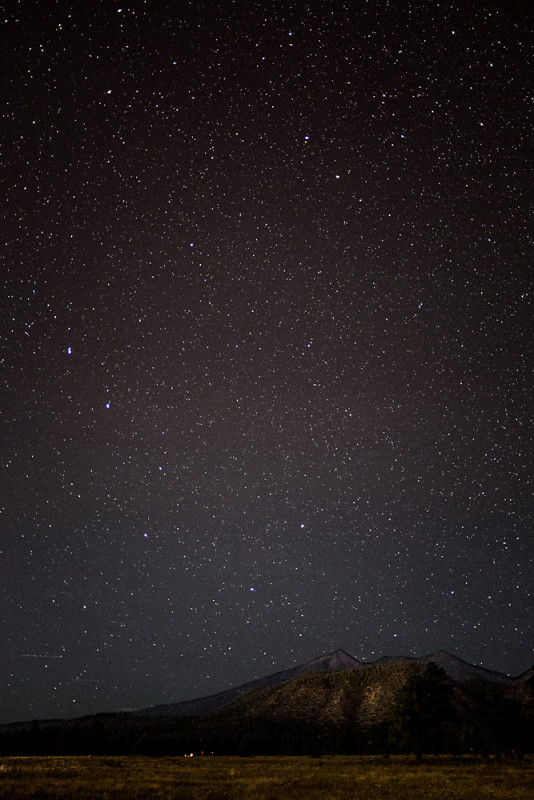
Autumn is a good season for night skies, here. It’s starting to dry off, so there’s less monsoon weather to chase us back indoors, and our Dark Sky City designation means there’s an attempt to keep city light from flooding out the stars. I signed up for a night sky photography workshop with Stan Honda, who is opening an exhibit at a community art center.

After a couple of hours of slideshow and demo of night sky techniques, we trooped outside and joined the nearby Dark Skies Star Party, an annual stargazing event aided by the likes of Lowell Observatory (Pluto, yo), the Naval Observatory and the university. We found a quiet stretch of paths and set up our tripods.

I started shooting with my old Pentax for the wider field of view its lenses give, but its low-light sensitivity just can’t compare to the Fuji, so I traded out quickly and spent the rest of the night experimenting with composition, ISOs, and exposure times. When I finally retreated, cold — I had forgotten my jacket in the warmish evening — I hoped I had a few keepers. With some adjusting in Lightroom, this is what I came up with.
lightbox2

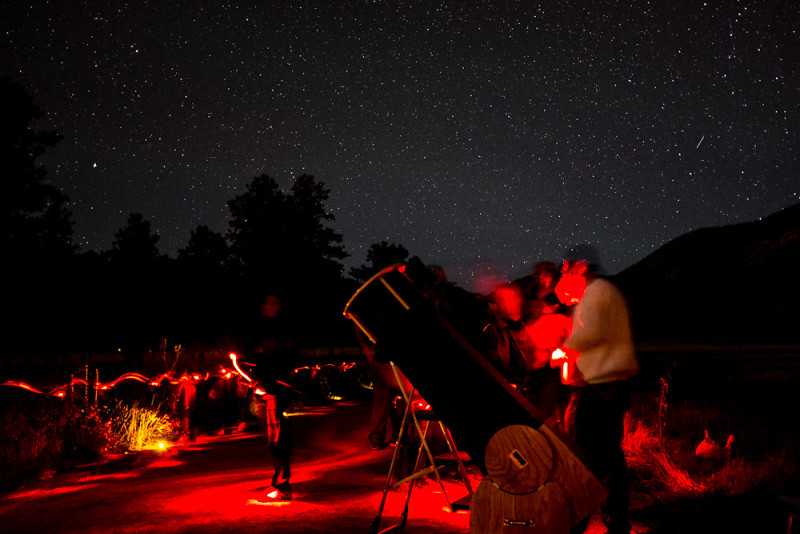
One of the things that resonated most from Stan’s slideshow were the descriptions of the event of some photos, particularly an expedition to the near-Arctic to shoot a solar eclipse. He showed some photos of the lineup of viewers to the eclipse and I liked the story that the photo told, so I experimented with a few of my own in the same theme. This is of one of the telescope stations at the star party, with viewers coming and going in the dark, with their red-lensed flashlights, beneath the stars.
lightbox2

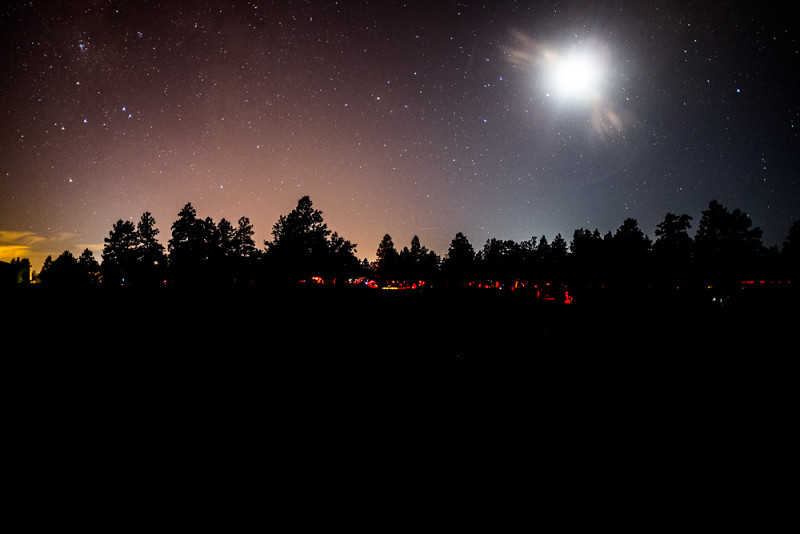
Looking back toward the main path from my spot in the fields, moon shining over us.

lightbox2 lightbox2


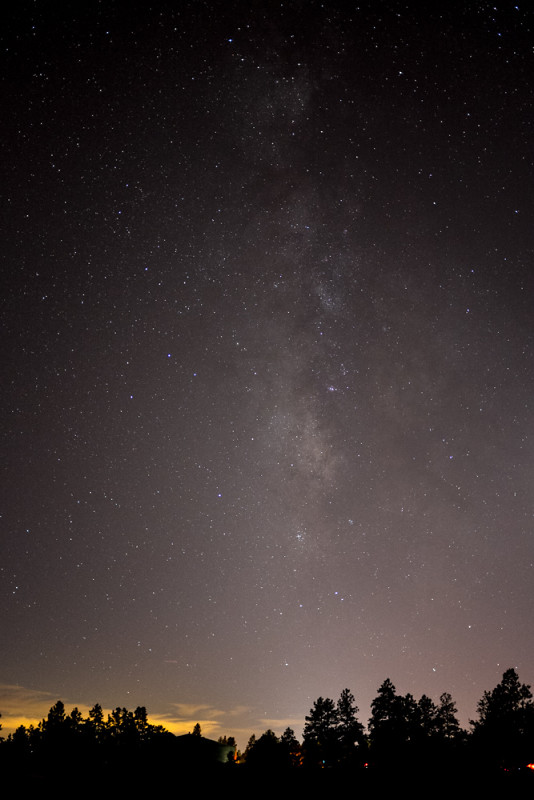
Stars over the San Francisco Peaks are really something. One more reason I’m happy and lucky to get to live where I do.

Slow, Small Data

Via this writeup in Fast Company, Dear Data is such a cool project. Giorgia Lupi and Stefanie Posavec are spending a year exchanging a postcard per week, in which they each draw a representation of a specific behavior or facet of their lives. The front side of the postcard is the drawing itself, and the back side describes how to read the visualization.
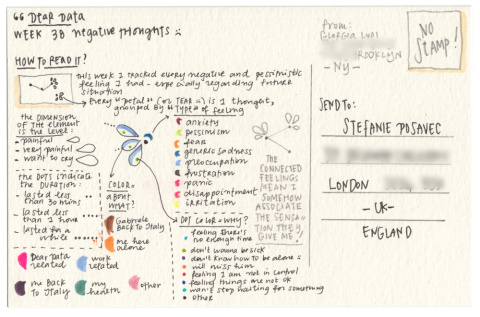
Both images by Giorgia Lupi from “Week 38: A Week of Negative Thoughts

One of the things that really makes me love this is the intentionality and immediacy of it. I used Reporter for several months, but fell away from it; it started to feel like something that would add value someday, but in an undefined way that didn’t keep me with it. By contrast, Stefanie and Giorgia are deciding on something very particular, measuring it and then drawing it all within about a week. Unlike so much “big data” they aren’t looking for a long-term pattern or a huge number of observations. Their illustrations are colorful and capture sparks of their personality while describing whatever they chose to measure; and the differences between their drawings are a reminder of the many ways to tell a story with a common theme.

How Invisible, Inc. Gets It Right

This analysis by Robert Yang hits so much of what makes Invisible, Inc. a great stealth game.

You can always lose more. Unlike every other stealth game, slow and patient observation usually means slowly suffocating death here.

Incapacitating many guards the first time is easy; but they wake up again! You have to carefully time using your stun guns because they recharge slowly over several turns. Likewise, taking enemies out for good is hard and expensive, because you may never again get more ammo for that gun (if you even have something that’s effective against their armor).

Because guards are rarely actually out of the game, every turn puts you in more danger of being overwhelmed, caught without the resources to get to your goal. It’s a constant struggle between pushing just a bit further and getting in way, way over your head.

Robert’s description of a perfectly-laid out plan foiled by one tiny unexpected detail is basically the game in a nutshell: Flashes of “I’m brilliant!” colliding with “OH NO!” and it’s a great, great time.

Apple Music, so Far

Looks like my pre-release Apple Music thoughts are mostly bust: No API so far, no good last.fm connection, no clear way to migrate existing playlists from other services such as Rdio.

And there’s more it doesn’t have, like any kind of coherent cross-device connectivity: No way to listen on the iPhone, then pick up the same playlist or album when I get home and open up my MacBook. The ‘Recently Played’ smart playlist occurred to me to be one way to get to this information, but it’s unreliable, usually omitting about seventy-five percent of the tracks I have listened to. This is honestly really puzzling, and frustrating, especially given Apple’s emphasis on hand-off between devices. Perhaps the recently played list only shows those tracks that are in my own, actual catalog? If so, I’m even more confused about how to think about “my” music versus the service’s catalog. It’s supposed to make that distinction irrelevant, but it seems to emphasize it in unpredictable places.

There are also some interface issues. This is a clicky, clicky application. (Rdio, which has become somewhat inscrutable sometimes, is so much cleaner.)

So why keep using it, when Rdio continues to behave the way I much prefer? Well, a couple of things: First, the curated playlists are good. They are well-titled, have useful descriptions, and the ones that show up in my 💓 “for you” section are a pretty good match for my tastes. This is in contrast to everything algorithmic that I’ve ever tried, which just never felt right to me. I have been enjoying listening to them a lot.

Capturing this discovery, on the other hand, is tricky: Whereas when I have a last.fm connection going, and can return to the day’s plays and easily flag something that I loved, with Apple Music, if I don’t capture that right in the moment, I’m much more likely to lose it.

Also, Siri integration is slick. I mean, really cool. Driving in the car, I can just tell my phone to play me an album or a song, or a playlist. This has made impulse listening so easy and fun. And when my son requests his current favorite song from the backseat, I can just tell Siri to play it, no fumbling through playlists and menus to get to it. (On the other hand, he will quickly understand that I can no longer use “Dad’s driving, son, I can’t find ‘Fireproof’ for you right now.”)

Finally, I really like the unification of my own library with the Apple Music catalog. While I continue to share the feeling that it’s often unclear what the status of my own music is 1, it’s great to be able to can mix something from my home catalog with a playlist from Apple Music when I’m out with my iPhone. Another benefit of this integration is that I’m listening to my own old playlists from iTunes once again. There are tracks there that I haven’t listened to in years, and my only excuse is that iTunes became such a bloated and byzantine mess that I tried as much as possible to avoid it. Now that they show up in Apple Music, I am really, truly enjoying them.

I think Apple has done something very smart with the long free trial of the service. If they iterate quickly on some of the interface details and expand on the cross-device support, during this time when they service is still free, I think they’ll have something competitive and compelling. I hope that they do, because there’s a lot here to like, but I’m not turning over my keys to Rdio just yet.

Oh, one more thing: I didn’t like the “play blah blah in Apple Music” cruft that the app adds to a URL that you share from it, so I made a quick and dirty Workflow share extension that copies a track, playlist, or album URL to the clipboard. Here it is.


  1. Is it in the cloud? Is it ‘matched’ or purchased, will I lose my canonical copy somehow? Is something happening with my metadata while I’m not looking? ↩︎

At Rock Paper Shotgun: The 50 Best PC RPGs

I love the big game lists that Rock Paper Shotgun puts together, and this massive list of RPGs is a fine example of the form. Baldur’s Gate II, FTL, Dungeon Master I mean Legend of Grimrock, Eye of the Beholder, Ultima VII, Pool of Radiance … the list goes on, with references to good contemporaries to the classics.

A couple more Apple Music notes

Last year I made a few totally uninformed notes about Apple’s purchase of Beats, which we now know is resulting in the upcoming Apple Music – a curated, streaming radio and music streaming service that looks functionally (so far) a lot like Rdio and Spotify.

I use Rdio a lot, and I was thinking while I was driving around this morning about a couple of things that I hope Apple Music eventually will offer. The first is a hook to last.fm to scrobble the songs I listen to. Last.fm has continued to be one of those services that I just keep using. I like being able to gets its view of my musical history, and I’ve also connected it to slogger, so I have an ongoing log in my Day One journal. I would miss not having that ongoing record.

Here’s the important one, though: Apple needs to realize, especially with their intent to launch an Android app, that their target customers are already using a streaming service, and they have to help them cross the river. They need to carefully consider the maturity of services that they’re competing with: If a Spotify friend posts a playlist, I can use re/spin to build the same playlist in Rdio. And if I’m to migrate outright from Rdio, how will Apple help me move my playlists, favorites, and collections? I hope for an API, because that will also help me get my last.fm hook. I guess we’ll have some idea in a few days. Fingers crossed.