Of course, there’s power in pretending like this is about free speech. Or good business. Or wise politics. Even to oneself. And I have to imagine that Mark Zuckerberg and those who are surrounding him have countless self-justifications for their actions. But I still cannot imagine sitting in a room writing a script for explicitly justifying hate speech and harassment directed at a specific population with religion as the explicit excuse. Who was in that room? How were they justifying the text they were creating and publishing? Did anyone recognize the echos of history here?
- Ethnographies of Datasets: Teaching Critical Data Analysis through R Notebooks by Lindsay Poirier, UC Davis.
- Modern Plain Text Computing, another very good resource from Kieran Healy
- Several best-of lists of board games to check out:
- Friday Night Meatballs: How to Change Your Life With Pasta
- This great piece modernity is stupid: a rant not about politics:
- ggview, which helps generate canvases of the right size for ggplot output
- Here’s the Southeast Seattle Tool Library where I searched for a hedge trimmer. I should still go check them out sometimes. Tab closed.
- Fifteen or so totally different tabs with view of last summer’s Posit conf. Tabs closed.
- Do Photo a book about practicing photography. Tab closed.
- I was looking for a new backpack last summer.
- Vicki Boykis’s What Are Embeddings. Tab closed. (PDF saved)
- All 50 Security Drone Locations in Destin 2 Season of the Seraph. Tab closed. (Drones got)
- How to open a file in Emacs. Tab closed.
- Deb Chachra’s wonderful essay Care at Scale: Bodies, agency, and infrastructure.
Time for Closing Tabs, vol. 2, in which I once again dive deep into the hundreds of open Safari tabs on my phone and unceremoniously close them. Today’s offerings to the cache gods:
One of the other options Omniverse suggests for moving off of its service is self-hosting, which is akin to telling me to go fuck myself. Self-hosting is great if your hobby is self-hosting things. Mine is not.
Closing Tabs, you don’t have to get read but you can’t … stay … here.
Family are out for an after dinner walk, so I’m listening to some music, sitting on the living room rug in the speakers’ sweet spot, with the volume at Slightly Unreasonable.
Welcome to Closing tabs, vol 1: In which I cull neglected open tabs from my mobile browser.
I have too many tabs on on my phone. Today I’m rapidly scrolling and closing, but finding some curiosities that might, might be worth noting.
Trying to be a tiny bit more intentional about capturing and annotating things, I’m experimenting with a link/dev/snippet log – new, (again) over at the datablog. One entry so far; let’s see where I take it.
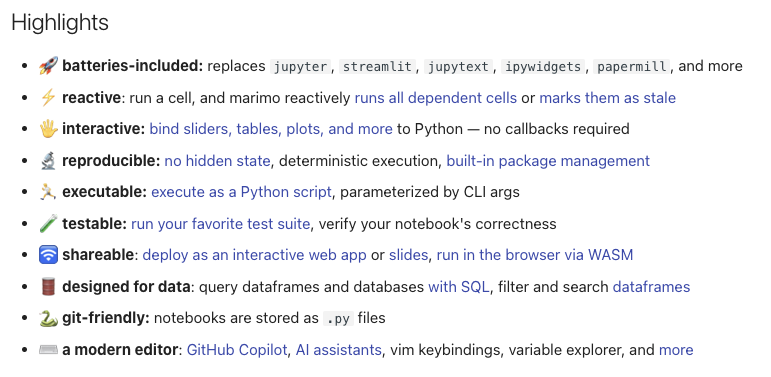
I vastly prefer writing and working with R to Python, but marimo is a really interesting tool and addresses the thing I’ve always disliked most about jupyter notebooks – the awful json file format that stores state in the document itself. Its browser-based editor feels pretty nimble and modern, too. I’ll explore it some more.
Over at the datablog, I wrote up some details on producing my 2024 workout summary from Peloton and Apple Health data. This was a fun little project to tinker through over my holiday break.

