Being a Better Reader
In Songs About Songs Robert McGinley Myers nicely describes some of the tension in blogging between producing one’s own original material and “chattering” as John Roderick called it recently, or deluding ourselves that meta-commentary is more substantial than it may really be. The best reader-writers are doing more than pulling from the massive volume of internet firehose stuff, synthesizing themes and ideas and presenting it back to their own readers. Which isn’t to say that kind of synthesis isn’t useful, valuable, and important, but unless it has a perspective of its own, well, it’s just a conduit.
Robert McGinley Myers:
But I’m not sure I would draw such a qualitative distinction between primary and secondary source material. Songs are not empirically better than linked list blog posts. I’d rather read a brief but beautifully crafted post on Kottke or Daring Fireball than listen to a lot of the songs currently on the radio.
Yes, but I think the differentiating factor is that a carefully observed link post at Kottke and Daring Fireball is also part of a portfolio. Readers know that Jason and John have a perspective that they bring to what they share — and what they note about it — because those smaller shared bits are part of their long writing histories, even when the added comment is brief (like a “Finally.” from Gruber). But let’s be fair to pop music, where an observer-fan might fit this year’s hit albums into a trajectory of musical themes or innovations, and therefore find much more depth and meaning to enjoy than Robert or I will.1
This is actually one reason I really enjoy reading reviews; I’ll never play, watch, read, or listen to most of the reviewed works, but I like understanding what deep subject matter experts/enthusiasts find interesting — or not — in their topics.
This line of thought started with wondering where and how to add value to a conversation about things that interest me or move me somehow. (Why it’s compelling to do this is probably another entire thing that goes back to that ever-since-the-1990s enthusiasm for making stuff online, a stint of being a scholar-blogger, and an ongoing desire — perhaps a desperate one — to do something expressive in a medium that I know a small something about.) So I’ll take as stipulated for now that a good conversation can come from both a) “primary source” (that is, original) material and b) shorter links and sharing that are part of a larger body of work, both of which represent a creative and thoughtful perspective; and then I would make a proposition based on my own dilemma: I’m not a good reader anymore.
Right now my Instapaper Gap (that’s the daily rate at which I actually get to sit down and read over the daily rate at which I accrue things to read) is hovering awfully close to zero. It’s an almost entirely aspirational tool because I’ve developed a terrible habit: I squirrel stuff away partly because I want to read it, but partly because I daydream that I’ll write about it, get engaged in the conversation and interaction and in so doing find something rewarding beyond that which comes from just, simply, reading something good.
I’ll go further: I’m a bad gamer, a decidedly mediocre listener, and an absolutely terrible viewer, because my focus is so torn between enjoying/learning/understanding, on one hand, and meta-level multitasking of all sorts on the other. In my defense, I have a three year-old, work a full-time job, and my resulting time/attention span is bifurcated in all sorts of ways. But come on, would it kill me to re-learn how to focus on things?
So I’m working on being a better reader.2 I’m just reading for its own sake, to appreciate whatever an author wants to make me feel or make me think about. This does not mean being unreflective or passive; rather, it’s letting me enjoy and focus in a different way. The Instapaper gap may not be narrowing, but it’s not approaching zero quite as quickly. And when I feel like there’s something for me to say, the overhead is perhaps a little easier to clear out.
Note: I started this post a couple of weeks ago as a draft and ended up publishing it unfinished and not realizing it. When I realized this was on the front page, I figured it was time to shore up my thinking. If you happened across that half-finished copy, well, thanks for coming back anyway to read some more.
-
Self-conscious “stream” reference there, yes. ↩︎
-
Notably, while publishing platforms proliferated, the Reader web interface was, to my fuzzy recollection, the by far dominant method to read one’s news feeds, despite a great variety of other good clients that used Reader as their backbone. ↩︎
-
Technically, many of these publishing-platform islands do provide and support RSS, even if you have to look for it, but without the centralized service to update and access them it’s just too difficult for most users who have not migrated to feedly or feedbin to read them across their various machines and devices. ↩︎
-
There’s a notion that this is all democratizing technology allowing everybody to have a voice, and that’s still true to an extent, but mostly in only the strictly technical sense; there’s a stratification of voices and a real class system out here. ↩︎
- VSCO + Fujifilm X100S — Experimenting with the very good VSCO film packs. I’m making a lot of use of Film Pack 02 these days, fond of several of the Kodak-style presets in particular. (some samples here)
- Making pictures — thinking about and eventually getting a new camera. Six months on, I find the photos from my X100s to be better and better as my use of it improves.
- pretty good hat home
- Integrating Runkeeper with Day One via Slogger — I am continuing to get a lot of pleasure from the connectivity to my various social spaces that Slogger provides, and I’m quite happy that the runkeeper connection works nicely (despite the initial setup of the API credentials being a chore).
- Alfred 2 workflows - managing a to-do list. Alfred is among the set of every good tools that enhance using my Mac. I wish I had a good equivalent at work.
- Total entries: 71
- Total “brief” (link or notes) posts: 35
- Total words: 16,154 (not including this post)
-
I’m very happy that kramdown creates compatible footnotes from markdown. This is an example. They’re nice. I’ll probably tinker some more with styling and such. Dr Drang recently discussed his implementation. ↩︎
Text Editors Data Update
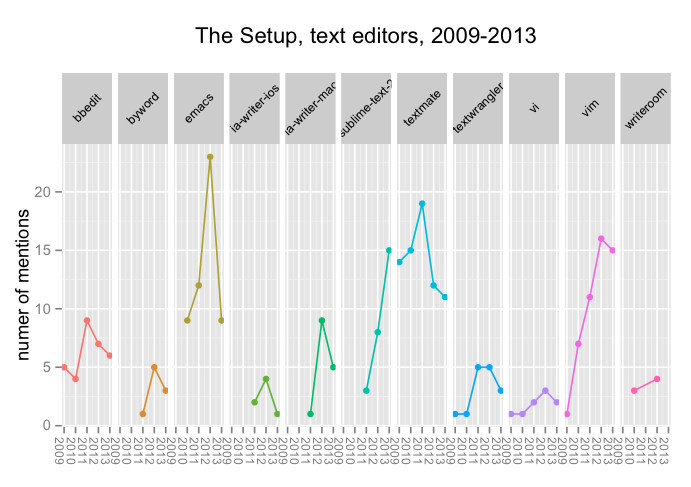
Following up on a skim of text editor data from The Setup last summer, I thought I’d catch up now that the 2013 information is in. It’s been quite a while since I dove deeply into the source data at The Setup, so it’s possible I’m missing new editor trends; I should read up on the interviews again, but meanwhile this is another fun, quick snapshot.
 {:id: .center}
Looks like after its 2012 surge, Emacs dipped steeply, while vim remained high and Sublime Text 2 grew in use (mentions) substantially. Among new, popular tools last year, Editorially has a single mention in the data, and Editorial doesn’t yet show up.
Meanwhile, interviewees at The Setup appear to remain remarkably unsympathetic to Windows Phone devices:
    Mobile Devices:
    ---------------
    iPhones: 		218
    iPads: 		145
    Androids: 		88
    Windows Phone:	1
Getting Better or Getting More
David duChemin, Towards Mastery. Again:
What will make better photographs is studying photographs themselves, not the ads for gear in the latest photography magazine. Photographs are made better by curious, patient, passionate, people with vision and imagination, not sharper glass. To paraphrase Ansel Adams – if the idea is crap then it doesn’t matter how big or sharp it is. Nobody cares how much damn chromatic aberration there is in your photograph; we care if there’s no heart.
The Year in (my) Photos
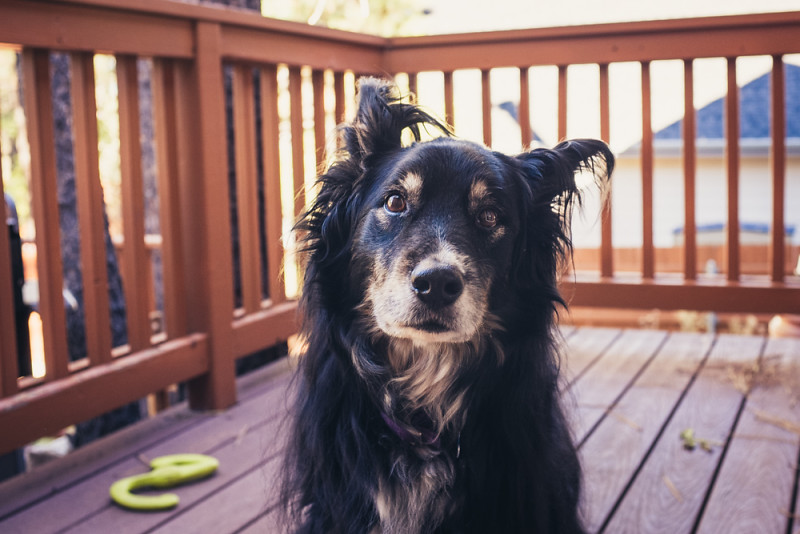
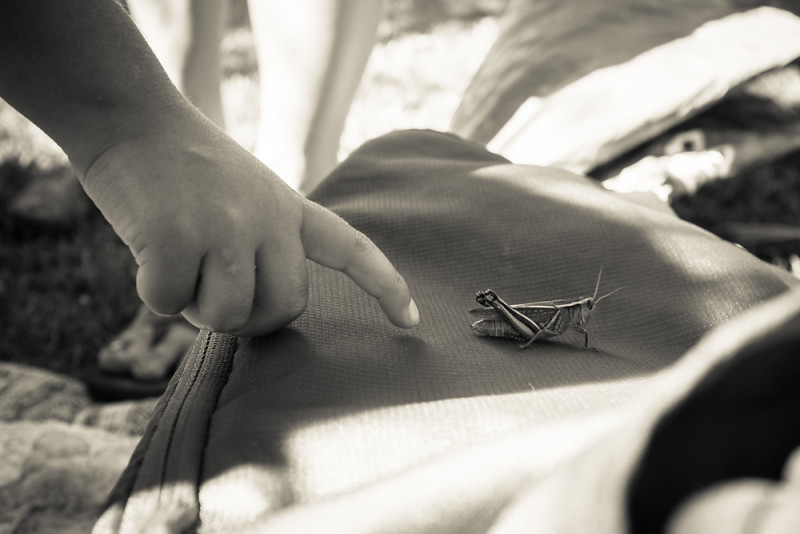
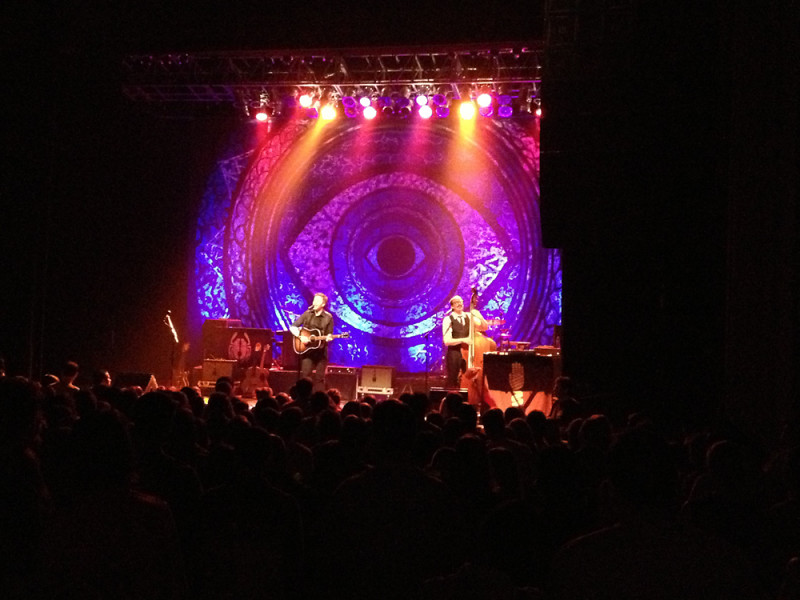
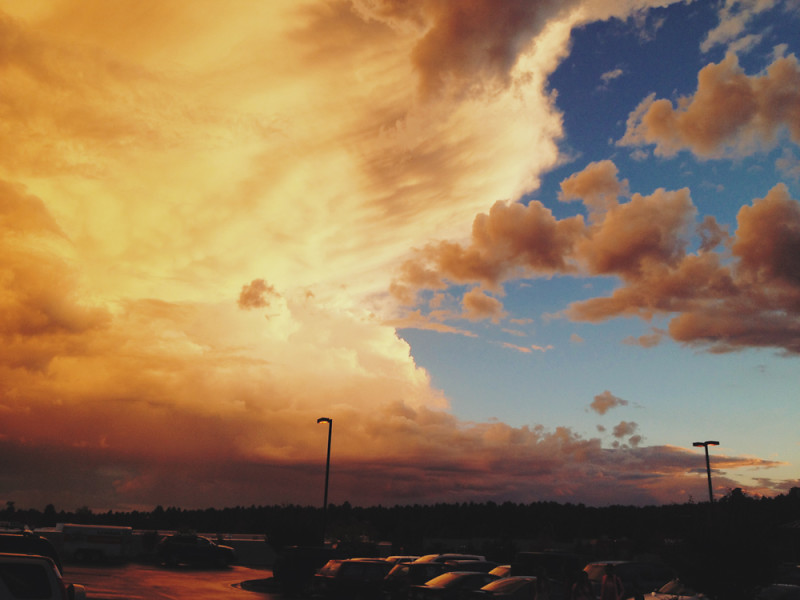
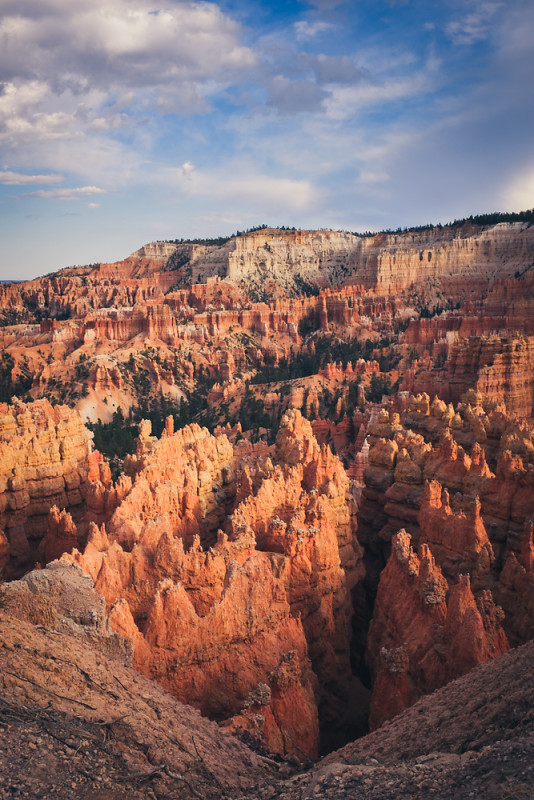
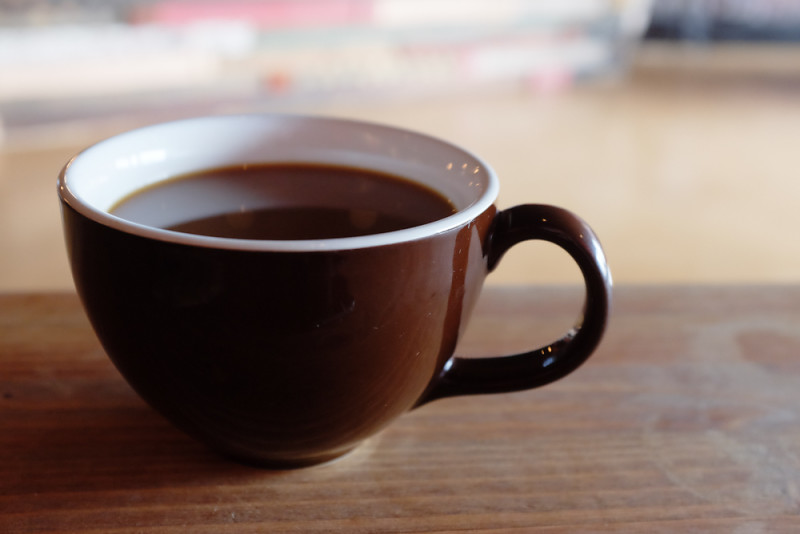
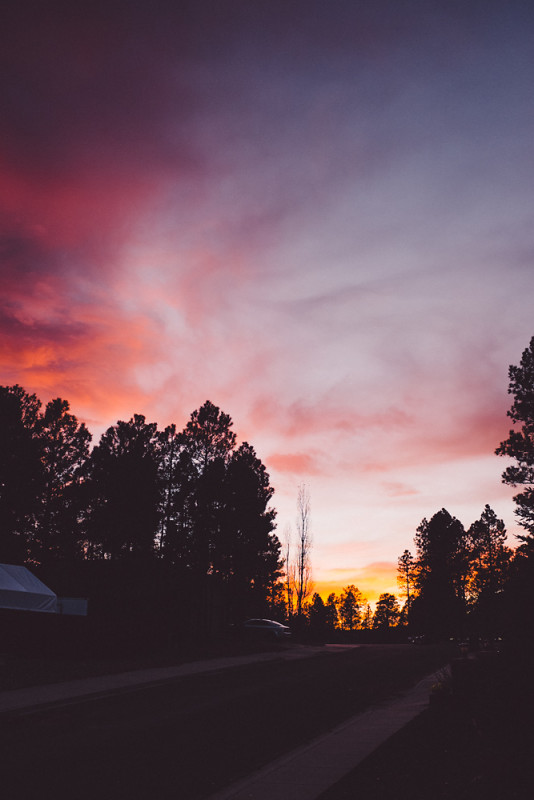
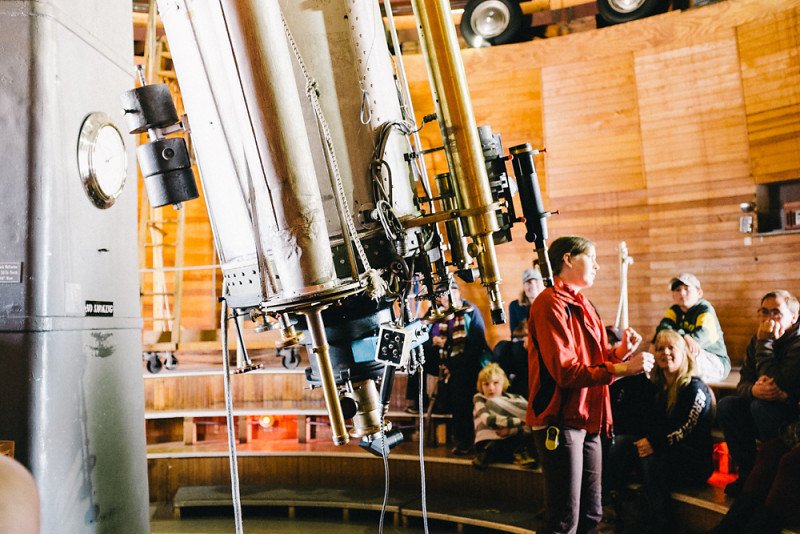
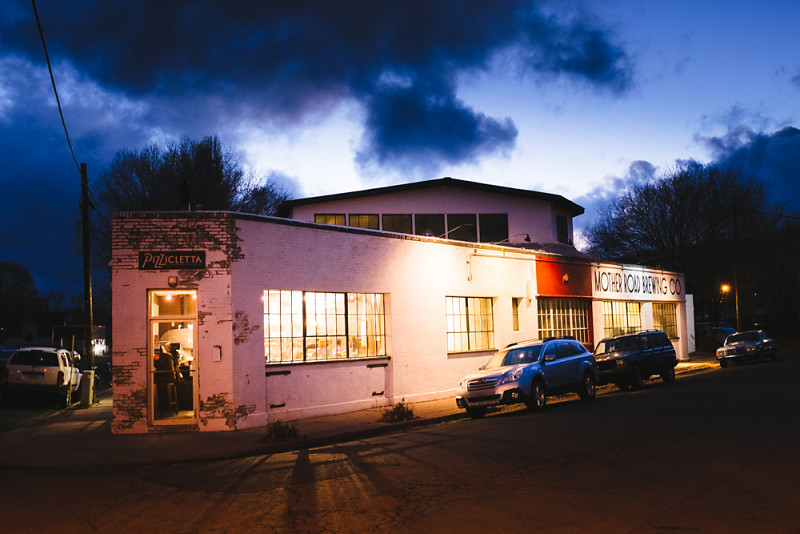
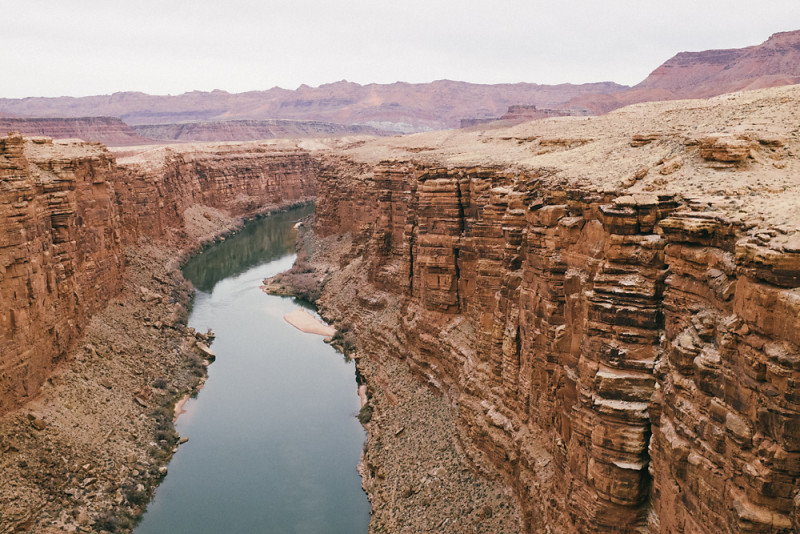
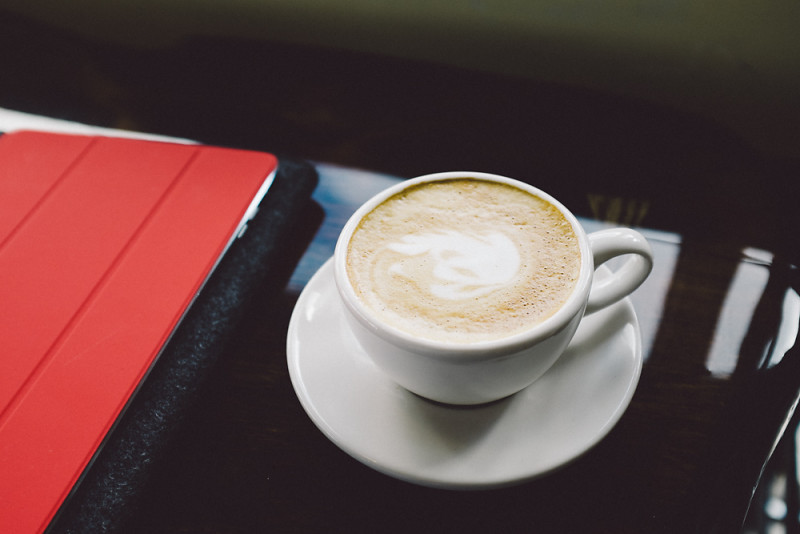
One of the things I really enjoyed last year was picking up photography again, reinvogorated by a new camera and its creative potential. By far the favorite photos I made through the year, regardless of camera, are of my wife and our preschool son, but those are just for us. These are a bakers’ dozen, particularly memorable for entirely arbitrary reasons, from among the rest.

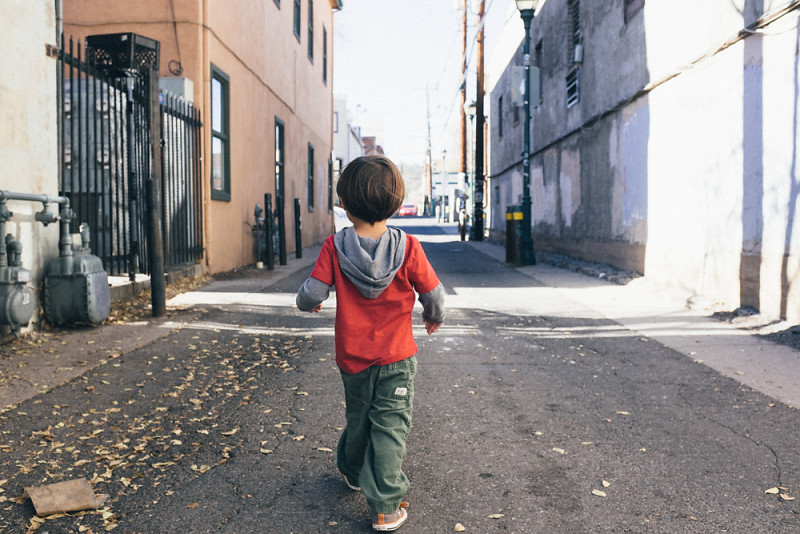
Wintertime Cooking: Homemade Pho
A brief exchange about pho over on App.net last week brought on a craving I couldn’t ignore. I really love Pho, especially in the wintertime when spicy, savory and aromatic broth feels just right. (To be honest, it’s great any time, of course. But it’s the kind of thing that feels particularly full of vitality when it’s cold and the sun still goes down early as it does the first week of January.) My mountain town has had a couple of Vietnamese restaurants come and go, and while the current one is hanging on it’s not really anything special. So after having had this vegetarian Pho recipe stored on pinboard for more than a year, I went for it.
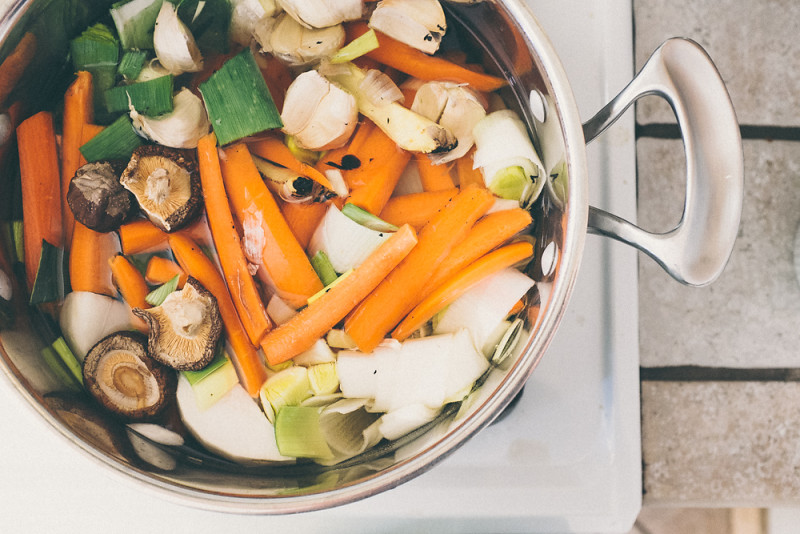

The broth is vegetarian except for the optional fish sauce. I’m not vegetarian and intended to put steak in anyway, so I kept the fish sauce for a little bit more funk and saltiness. While the list of ingredients initially was off-putting in its length, it’s really not so bad, and the prep was easy because everything goes into a big pot in big chunks (including the garlic, no peeling required).

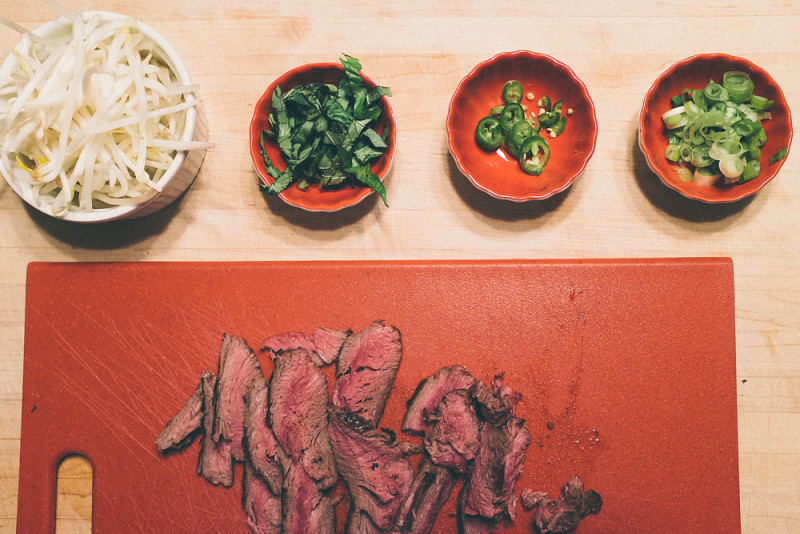
After a couple of hours simmering, the whole pot gets finely strained and you have this cinnamon- or mushroom-colored broth. It’s really lovely. We ladled it over medium-rare bison steak and garnished with bean sprouts, basil, peppers, lime and scallions. It was everything I was hoping for: Spicy from the fresh peppers and ginger and headily aromatic with anise, with just a bit of sweet balance coming from the turnip and depth from the mushrooms. Really good pho at home, I’m a believer.
By the way, I decided to put the bison steak in partly because a) I had it, but mostly b) I wanted to call this buff-pho-lo.
Brushfires & the Death of the Blog
Of course, the day after I fussed over my own post about dead blogs, I come across this insightful, thoughtful piece by Robert McGinley Myers. There are two key passages in particular that I think are just so spot-on: One that resonates some with my thinking about “casual” blogging amid a proliferation of sharing platforms; and one passage about what he hopes to find in the future of not-dead blogging. Read the whole thing, as they say. It’s excellent and makes me want to dive in and just read everything at Robert’s blog.
Hobby Blogging is Dead Unless it Isn't
Mid to late December saw a broad online conversation around Jason Kottke’s “The Blog is Dead, Long Live the Blog”. I didn’t catch up with that current1 until I read Duncan Davidson’s newsletter recently. Amid links to the Kottke essay, Alexis Madrigal’s thoughts at the Atlantic, John Scalzi, and Frank Chimero on “Homesteading”, Duncan writes
My own homesteading thoughts have lately turned not only to how to structure things on a website, but also how to share ongoing information in a way that’s timely. RSS feeds seem to continue to fade in importance and while they’re probably not going away entirely anytime soon, it’s clear that they solve only a portion of the problem.
The decommissioning of Google Reader is critical to all this. Reader was without question the hub of the reverse-chronological blog ecosystem, and Google’s discontinuing of the service created a significant sharing problem that also substantially amplified the extant trend toward “long form” writing and designery pieces like Snowfall, on one hand, and streaming social platform services, on the other. Google’s move underscores one critical piece of the story that Alexis Madrigal hits on, that “the stream is a creation of particular companies and thinkers” and not a natural product of the Internet. Whereas in 1997 “wired teens” (per Kottke) were proto-blogging with the shell accounts, ftp and web hosting provided by their colleges and ISPs, the advent of Blogger and later Google Reader would shift blog publishing and reading to a massive media landscape scale.
In the Reader+RSS era, a million ways to publish proliferated and Reader generally let them all bloom via RSS.2 I don’t think it’s an exaggeration to suggest that this infrastructure enabled what would become the Wordpress and Moveable Type empires; likewise the glut of shared web hosting services that somewhat tellingly are much more consolidated and cloud-service-oriented than they once were. I’m not trying to draw straight causal lines here, because many of these currents were on the rise prior to Reader becoming the dominant distribution and reading model, but I think it’s clear that as contemporaries they were all part of a particular technically-faciliated ecosystem that would eventually sit with Reader at its core.
Fundamentally, Reader+RSS was mostly plumbing; the services and platforms that are replacing it are not. So while we are (maybe) in a great age of diverse platforms we no longer have a unified way to consume them,3 and that’s a dilemma for people who want to read as well as people who want to create things. This may pose the largest impact to casual writers, the kind who might have fired up a hosted blog on a whim or periodically posted something of narrower or specialized interest. So much of the engagement once available to those authors has mostly dried up — while there is a bounty of ways to produce stuff, the ad hoc federations of interest collections is just harder to create and maintain without a dominant structure to put it all into. The kind whose writing is not short or pithy enough for microblogging or Twitter, not connected or viral enough to hit Medium or another curated platform4.
I have no illusions about this very site not being square in that category, but this isn’t meant to be a pity-party, only an observation/suggestion that the tools and infrastructure that for a time enabled a kind of media by the masses have again bifurcated into the micro-social and the truly mass media, and the kinds of things that survive in either of those environments are going to be different, except for blog-format sites that already have a mass readership (Daring Fireball among tech blogs, say, and Kottke and plenty of others). Everything else using that form will persist as a labor of love, an adjunct to a “more engaging model,” or a holdover from the pleistocene of the “home page.” As Scalzi writes, for those of us who want to own the things we produce and decide on our own how to present ourselves, the hobby home page is still something valuable:
I don’t see myself ever not doing Whatever, because at the end of the day I want to control my own space online and say what I want to be able to say, unencumbered by character limits or SEO-driven advertisements in the sidebars or any other sort of distraction. But if it turns out that it’s just one part of an overall online presence portfolio, well, that’s no different than it ever was … and it’s part and parcel of the fact that my presence is distributed in other ways as well
It’s clear that that function is no longer completed by that single site alone. Duncan Davidson’s newsletter prompted this post so I might as well bookend it with another of his remarks: On this shift from blog to something else, Duncan writes that “Whatever structure one uses, the urge to have one’s own presence online is certainly compelling.” For those of us who have been doing this since the 90s, that’s exactly right — and we’ll have to keep discovering and creating new ways to be expressive and find the social community to engage with.
Happy New Year
It’s January 1, 2014. I spent a good chunk of yesterday morning tuning up my still-incomplete backups over at TextDrive (as one does), enjoyed a couple of good cups of coffee and visited friends for a new year’s eve party (but did not make it until midnight; I turned into a pumpkin early and went home for a nice winter’s nap). Today I think I’ll try to bake some bread, cook some lamb, edit the pile of holiday photos I have amassed over the past week or so, and sip some bourbon.
As I type, it’s 45º F outside, so it’s possible that all this screen stuff goes out the window as I go out the door.
The Year's Bloggy Roundup and Administrivia
Piwik tells me that my top five hits here at PGH in 2013 were:
Since the build system starts with pure markdown, a tiny bit of wc at the shell can give me a few numbers:
Entries by Month:
Jan : *******
Feb : ***
Mar : ****
Apr : *********
May : *****
June: ****
July: ***
Aug : *************
Sept: ********
Oct : ***
Nov : ****
Dec : *******
Today I plugged in Bigfoot to add some flair to footnotes, just in case. 1 Otherwise, this little gig has been pretty stable behind the scenes. I expect I’ll continue to post mostly using the iPad, as I have since August when I hooked up my publishing workflow to Editorial. Perhaps I’ll do a lot more mobile writing next year; I have been happy with my nice weekend afternoon routine of taking the iPad to the coffee shop to catch up.
I enjoyed the writing and thinking I did here in 2013. I have a set of notes brewing, drafts to pick up in the next days or weeks (maybe should update that Usesthis editors post to see just what happened to TextMate in the latter half of the year). I’m looking forward to it and continue to welcome feedback and comments via contact information at the bottom of the page. Thanks.
Merry
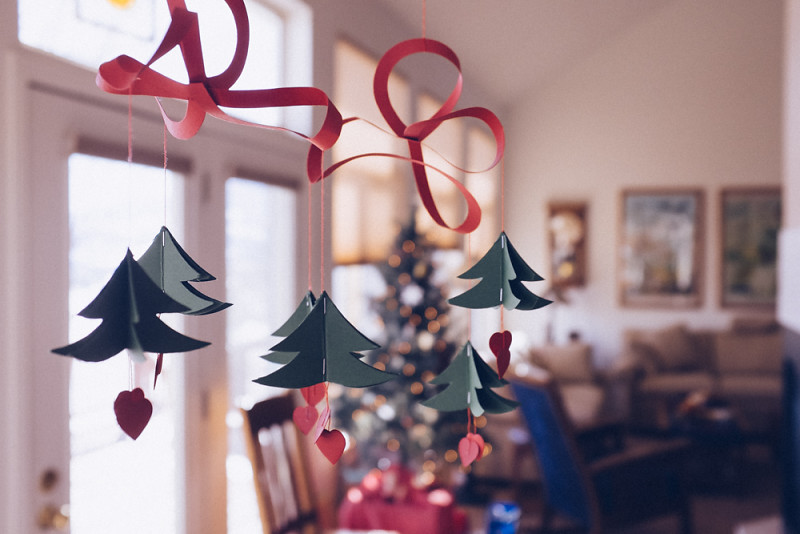
We’re home again after about a week traveling northbound to my parents’ house for Christmas. All in all, I’m exhausted. But it was a great trip, full of some wonderful memories: my son’s first time skiing (about which I can just say joy and glee and miles-wide grins) which I will remember for the rest of my life; meeting my new nephew for the first time; seeing many family and school friends for the first time in years; the way my son was perfectly happy — more than happy, content and Merry — with the very first present he found for himself under the tree, no expectations of more but then there’s more OMG (because of course there was, thanks, grandma and grandpa); feeding my nephew and rocking him to sleep; my wife being ill for most of the trip, sitting together quietly after the house had gone to sleep.
Recognizing in my son that these memories are forming for him, too, that he will remember pieces of the last week as he goes on through his own life, an evolving story that will one day be all his own.
Bring it on, 2014.