
Today’s last.fm data time produced this plot of my top 20 tracks for each year since 2005. I’m going to write a (much?) longer post about this, because it has my brain really spinning on storytelling with data; for now, enough to say I’m excited and having a good time!
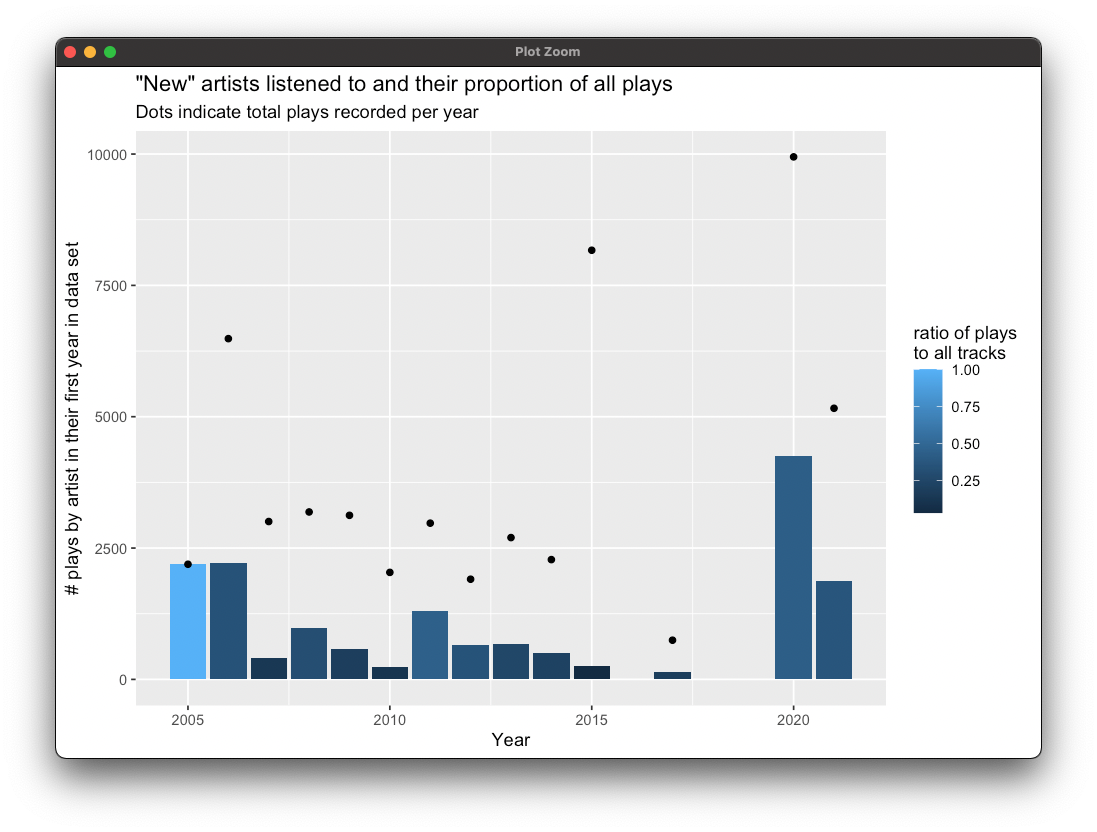
Continuing to tinker with last.fm data, I’ve built a tool to pull my per-track history, and I can do a bunch of fun things with that detail. This plot shows how much I listened to artists in their first year in my data set, compared with all listening in the same year.
Playing around with my last.fm stats Shiny app a bit more this morning, and I remembered how to get what I want out of a nested list returned from the API with only 20 minutes of cursing. Progress!
Made one more small adjustment this morning to tuneR, adding a date range selector to limit the query. It’s fun to see how my top artists change when adjusting that window.
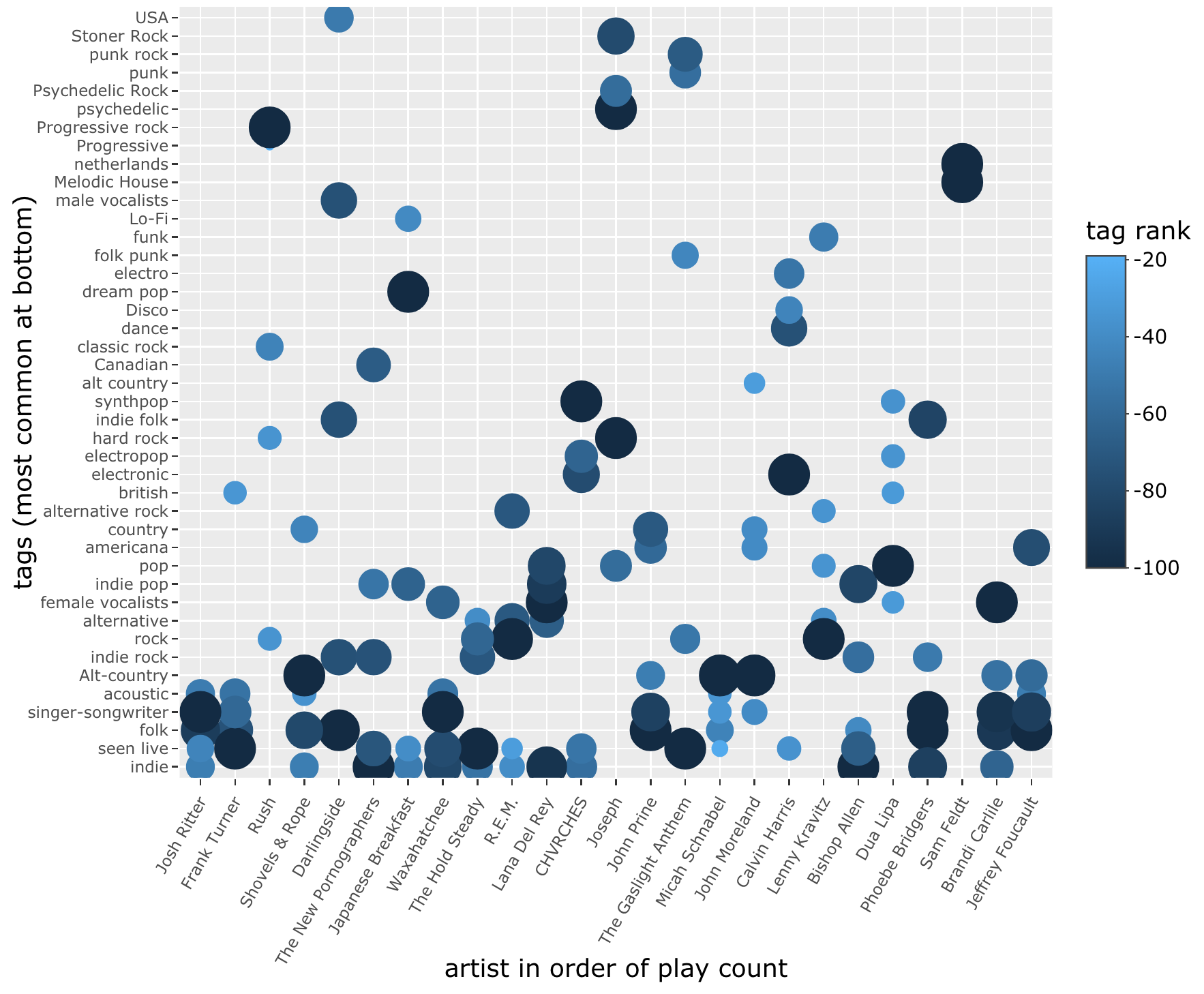
Okay, one final (probably) revision of tuneR for today, adding a bit of color and sizing to the plot of tags by artist, to show variation in tag rank within each artist.
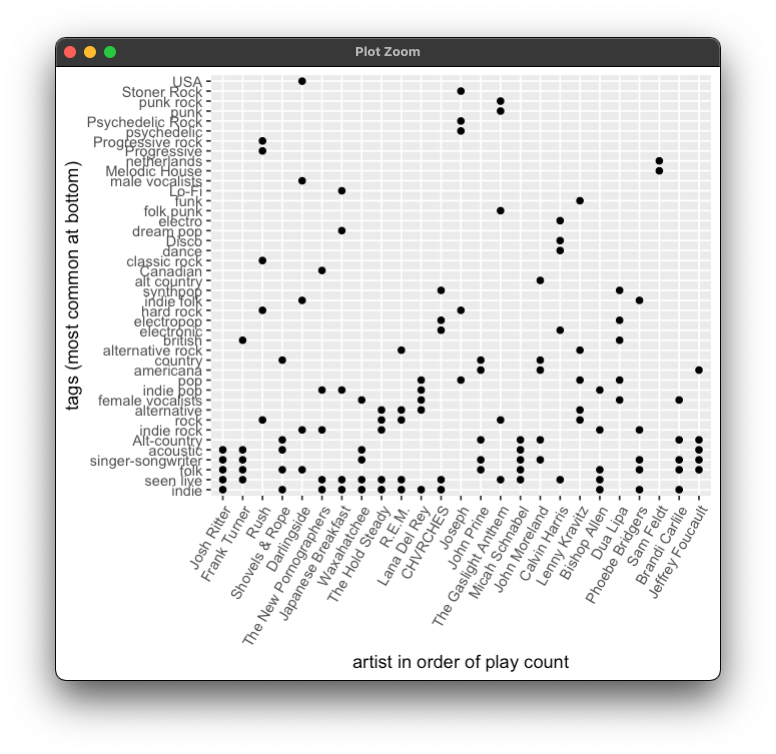
Today’s small revision of tuneR adds a scrollable table of user-assigned tags to your artists, and a plot of artists by tag sorted to show the most used tags across your top 25 artists this year. Coming soon – possibly some track-level data!
Destiny 2 Power leveling tool in R
The latest piece of my homebrew Destiny 2 toolset is Travelr, a power leveling tracking tool built with R and using a much simpler process than most of my prior nonsense. (Aside: I'm still using ArmoreR, but it has some key limitations that I haven't spent much time with, including a problem incorporating the authentication flow more fully into Shiny so that I could make it an app that others could use in a more friction-free way.)
The power climb is part of the game with each new Destiny season. A lot of this process is luck: A player can only get so many pinnacle drops per week and there's no guarantee that a given drop won't be in a duplicate category. But, some drops can be targeted to broad categories -- armor versus a weapon, for example -- and there is some efficiency across characters if you can strategically raise one category to increase the base level for all characters.
I was inspired by a fantastic tool written by a member of the small Destiny 2 community I'm in, that identifies categories to target (or, try to target, anyway; a lot of it is still frustrating random luck, sometimes), and decided to try building my own version. It doesn't do anything unique, but it works and it's wonderfully satisfying to step through an R markdown notebook that authorizes me to the D2 API, retrieves all my equipment statistics, calculates my maximum power level and indicates which, if any, categories should be targeted.
For example, here's a screenshot from the beginning of the season, where every single equipment type would increase my total maximum power level:

... and later in the season:

It's been great fun to have this small tool with me during the season's play. It's currently dependent on another small tool that grabs the equipment "manifest" file, and I'll be publishing the whole notebook to github when I finish incorporating that into the repository.